


Book Nook Gryffondor
Original price: $89.90
Sale price: $74.90
wood Miniatures
☑️ Designed to Last
☑️ For Adults and Children
☑️ Money-Back Guarantee
☑️ Numbered pieces : guided step-by-step assembly
☑️ Detailed instructions suitable for beginners
Couldn't load pickup availability
Magic Night Book Nook – Gothic Cathedral
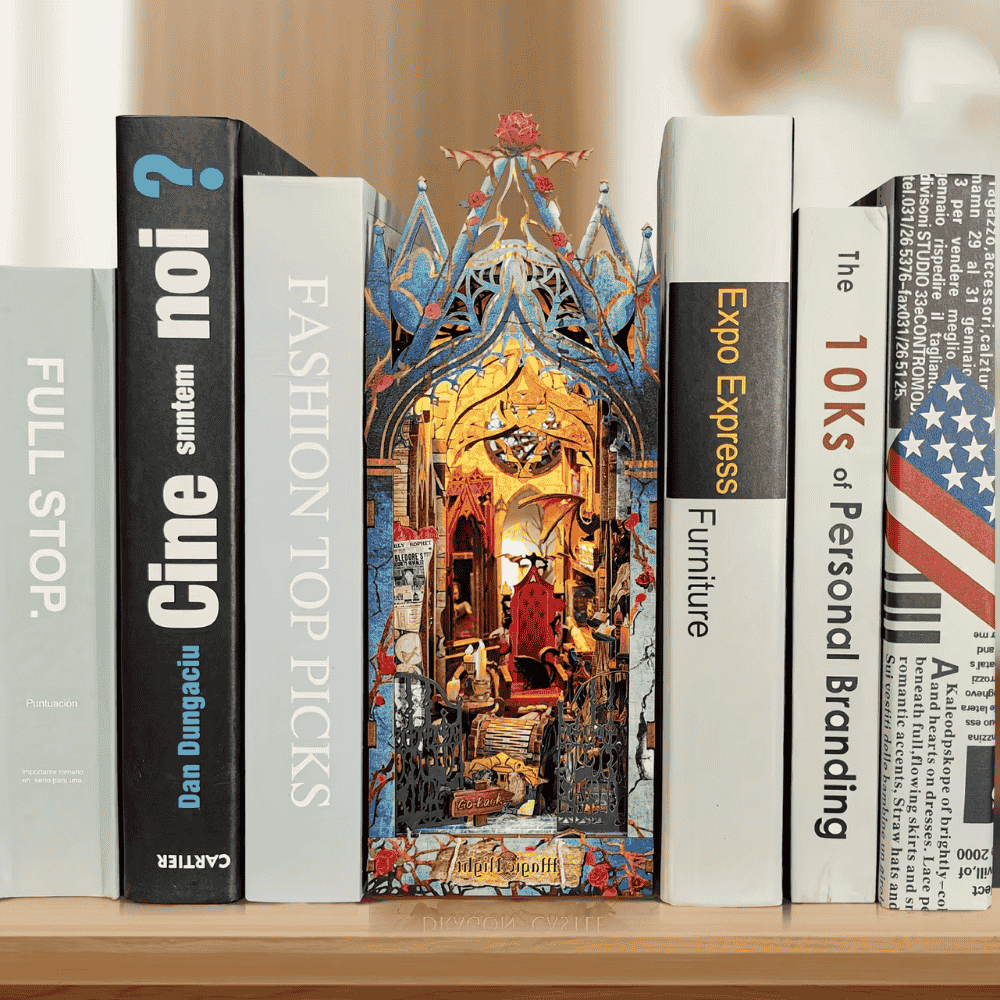
Gothic spires in deep teal and gold rising above a scene that has no business being this beautiful. Red roses climbing the exterior walls like something that was planted once and has since decided to take over. A crimson throne visible through the arch at the end of a long corridor. An iron gate across the entrance : ornate, elaborate, guarding the threshold between outside and whatever is inside. A black cat. A figure in blue. Dragons perched at the crown of the spires. And at the base, in gold script, a sign that reads simply: Go Back.
You won't.
Magic Night is the most architecturally ambitious book nook in our Fantasy collection. It's built on the visual language of the great Gothic cathedrals of medieval Europe and then it populates that architecture with everything a cathedral would officially deny but privately understand: magic, roses, thrones, dragons, the particular darkness that lives in beautiful spaces.

The great Gothic cathedrals of Europe : Notre-Dame de Paris, Chartres, Cologne, Westminster Abbey, Salisbury were built to produce a single, overwhelming effect: the feeling of being inside something that is larger than you, older than you, and operating according to principles you don't fully understand.
The pointed arches that seem to be reaching upward. The ribbed vaulting that distributes weight in ways that shouldn't work. The flying buttresses that look like the building is being held up by stone wings. The rose windows that flood the interior with colored light. The entire architectural vocabulary of the Gothic was designed to make a human body feel exactly the right combination of small and significant.
Magic Night takes that architecture and asks: what if it wasn't a church? What if it was the entry to something else a throne room, a court of magic, a space where power operated under entirely different rules than the ones written on stone tablets?
The answer is this book nook. And the answer is extraordinary.
The Roses: Red roses climb the exterior walls, coil around the iron gate, appear in the gargoyle niches at the spire crowns. In the Gothic tradition, the rose is a sacred symbol , Mary, beauty, the divine made visible. In the fantasy tradition, a rose always means something is about to happen. In Beauty and the Beast, the rose is a countdown. In A Court of Thorns and Roses, roses mark every threshold of consequence. Here, they mark the entrance to Magic Night and they are the most insistent thing in the scene.
The Dragons: At the apex of the gothic spires, two dragons are perched with their wings spread ,not gargoyles, not decorations, but something that chose to be here and could leave at any moment. In medieval cathedral iconography, grotesques and gargoyles were placed at height to ward off evil. These dragons ward off something else. Possibly visitors with insufficient imagination.
The Iron Gate: Across the entrance at street level, an elaborate iron gate with scrollwork and pointed finials, the barrier between the exterior world and the interior world. The sign below it says "Go Back." The scene ahead makes that instruction impossible to follow.
The Crimson Throne: Visible through the arch at the end of the interior corridor, a red tufted throne glows in the warm LED light — the destination at the end of the path through the gate, through the arch, through the darkness. Someone sits there, or should. The throne is never accidentally empty.



A Creative Moment Worth Slowing Down ForReady to step away from the screens and remember what it feels like to make something with your hands? At Ecocraft, we design responsible, thoughtfully crafted DIY kits built for exactly that bringing people together around a shared experience that's equal parts relaxing and rewarding. From realistic scenes to fantastical worlds, each wooden kit invites you to build a unique miniature from scratch, rich in detail and alive with character. Clear instructions and premium sustainable materials mean anyone can dive in, regardless of age or experience. Picture the finished scene: the warm glow of the LED light, the last piece clicking satisfyingly into place, and the quiet pride of having built something beautiful together.

You've always dreamed of a little magic on your bookshelf and you never have to leave your living room to find it. A book nook pulls you into a miniature world where every carefully placed detail tells its own story. Build it piece by piece at your own pace, guided by our illustrated manual, and discover the quiet joy of watching something extraordinary take shape in your hands. Premium sustainable wood, built-in warm LED lighting, and a support team with you at every step mean this kit is made for everyone first-timers very much included. Picture your shelf transformed: soft golden light, delicate textures, and that deep, unhurried smile of someone who just made something they're genuinely proud of. With Wood-miniatures, it's never just a decorative object. It's a moment you'll remember.


