


Book Nook Gryffondor
Original price: $89.90
Sale price: $74.90
wood-miniatures
☑️ Designed to Last
☑️ For Adults and Children
☑️ Money-Back Guarantee
☑️ Numbered pieces : guided step-by-step assembly
☑️ Detailed instructions suitable for beginners
Couldn't load pickup availability
Of all the flowers in the collection, the dahlia is the most structurally ambitious. A single dahlia bloom can contain over a thousand petals arranged in perfect geometric symmetry concentric rings that expand outward from the center in a spiral that follows mathematical precision more closely than almost any other flower in nature.
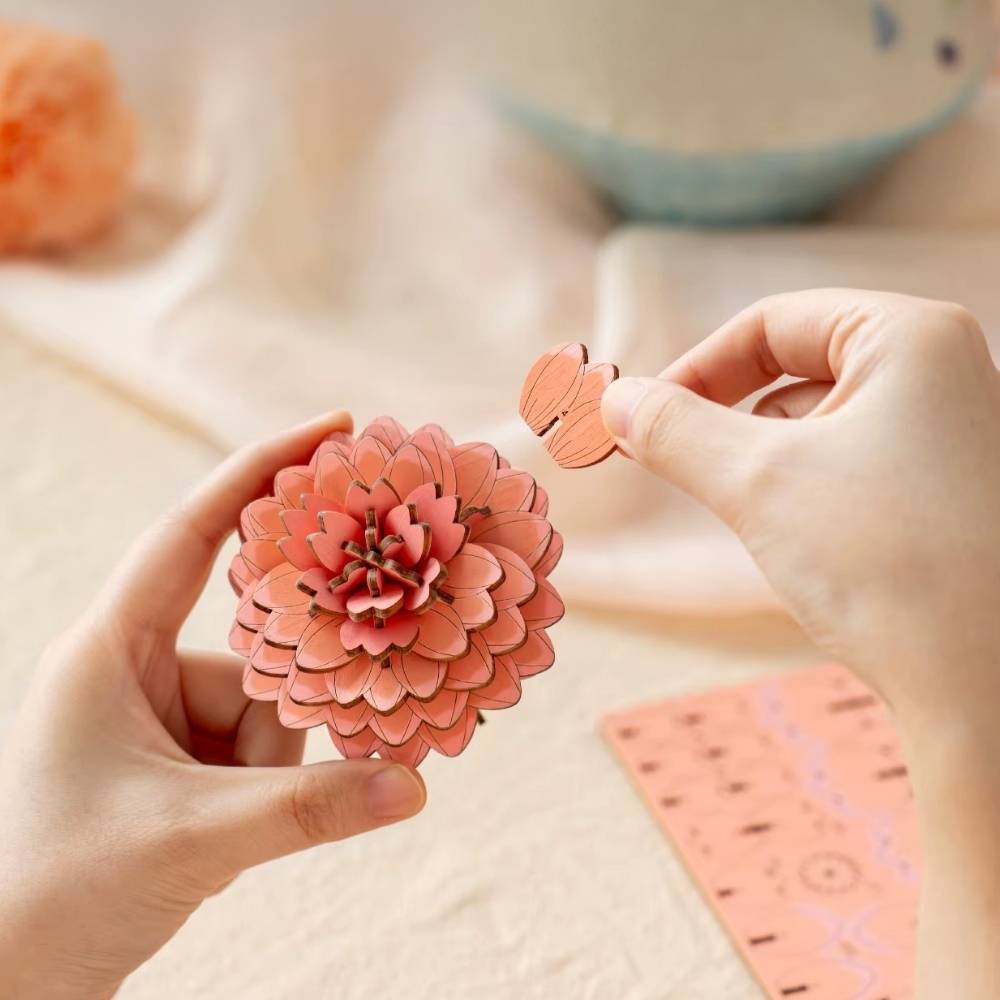
The Pink Dahlia 3D Wood Puzzle captures that structure in laser-cut wood : ring by ring, layer by layer, until the bloom is full and round and undeniably a dahlia. A side bud, still closed. A small accent flower with its own flat center disc. A tiny wooden bee at the base of the gift tag. A tapered botanical kraft vase with the familiar "For You" tag already tied on.
Build it for yourself. Build it for someone specific. Either way, the bee was always going to be there.
The most architecturally complex bloom in the series. The dahlia's concentric petal structure means the assembly sequence is layered each ring locks into the one before it. The result rewards the patience it asks for.

The dahlia arrived in Europe from Mexico in the late 18th century named after the Swedish botanist Anders Dahl and immediately became an obsession.
In the Victorian language of flowers, the dahlia carries one of the most emotionally generous meanings in the entire floral lexicon: elegance, inner strength, creativity, and the dignity of someone who has changed and grown. Where roses mean passion and lilies mean purity, the dahlia means something more complex, it's the flower for someone who has become more themselves over time. It's the flower you give to acknowledge transformation.
The pink dahlia in particular is associated with grace, femininity, and the kind of love that doesn't announce itself loudly affection that's present and consistent rather than dramatic. The Aztecs, who cultivated dahlias long before European contact, used them medicinally and ceremonially the tuberous roots were a food source, and the hollow stems were used as water pipes. The dahlia that became the obsession of European gardens was, in its original context, a practical plant. Beauty and usefulness in the same flower.
The dahlia also holds a specific place in the history of competitive horticulture. The National Dahlia Society in the UK, founded in 1881, was one of the first flower societies to develop formal exhibition categories and the dahlia's geometric complexity made it the ideal subject for competitive breeding. Today there are over 57,000 registered dahlia cultivars. No other flower has been more systematically explored in pursuit of the perfect petal arrangement.
Building the Pink Dahlia ring by ring is a small, compressed version of that pursuit: the attempt to capture, in a controlled medium, what the best dahlias have always been, geometrically perfect, quietly extraordinary, and worth every petal.



A Creative Moment Worth Slowing Down ForReady to step away from the screens and remember what it feels like to make something with your hands? At Ecocraft, we design responsible, thoughtfully crafted DIY kits built for exactly that bringing people together around a shared experience that's equal parts relaxing and rewarding. From realistic scenes to fantastical worlds, each wooden kit invites you to build a unique miniature from scratch, rich in detail and alive with character. Clear instructions and premium sustainable materials mean anyone can dive in, regardless of age or experience. Picture the finished scene: the warm glow of the LED light, the last piece clicking satisfyingly into place, and the quiet pride of having built something beautiful together.

You've always dreamed of a little magic on your bookshelf and you never have to leave your living room to find it. A book nook pulls you into a miniature world where every carefully placed detail tells its own story. Build it piece by piece at your own pace, guided by our illustrated manual, and discover the quiet joy of watching something extraordinary take shape in your hands. Premium sustainable wood, built-in warm LED lighting, and a support team with you at every step mean this kit is made for everyone first-timers very much included. Picture your shelf transformed: soft golden light, delicate textures, and that deep, unhurried smile of someone who just made something they're genuinely proud of. With Wood-miniatures, it's never just a decorative object. It's a moment you'll remember.


