


Book Nook Gryffondor
Original price: $89.90
Sale price: $74.90
wood Miniatures
☑️ Designed to Last
☑️ For Adults and Children
☑️ Money-Back Guarantee
☑️ Numbered pieces : guided step-by-step assembly
☑️ Detailed instructions suitable for beginners
Couldn't load pickup availability
You've imagined it since you were a child a house in a tree, hidden above the world, reached by a winding stair and lit by something warm. Not a fantasy castle, not a haunted tower. Something gentler. A treehouse in a cherry blossom tree, on a spring afternoon, when the whole world is pink and soft and briefly, perfectly still.
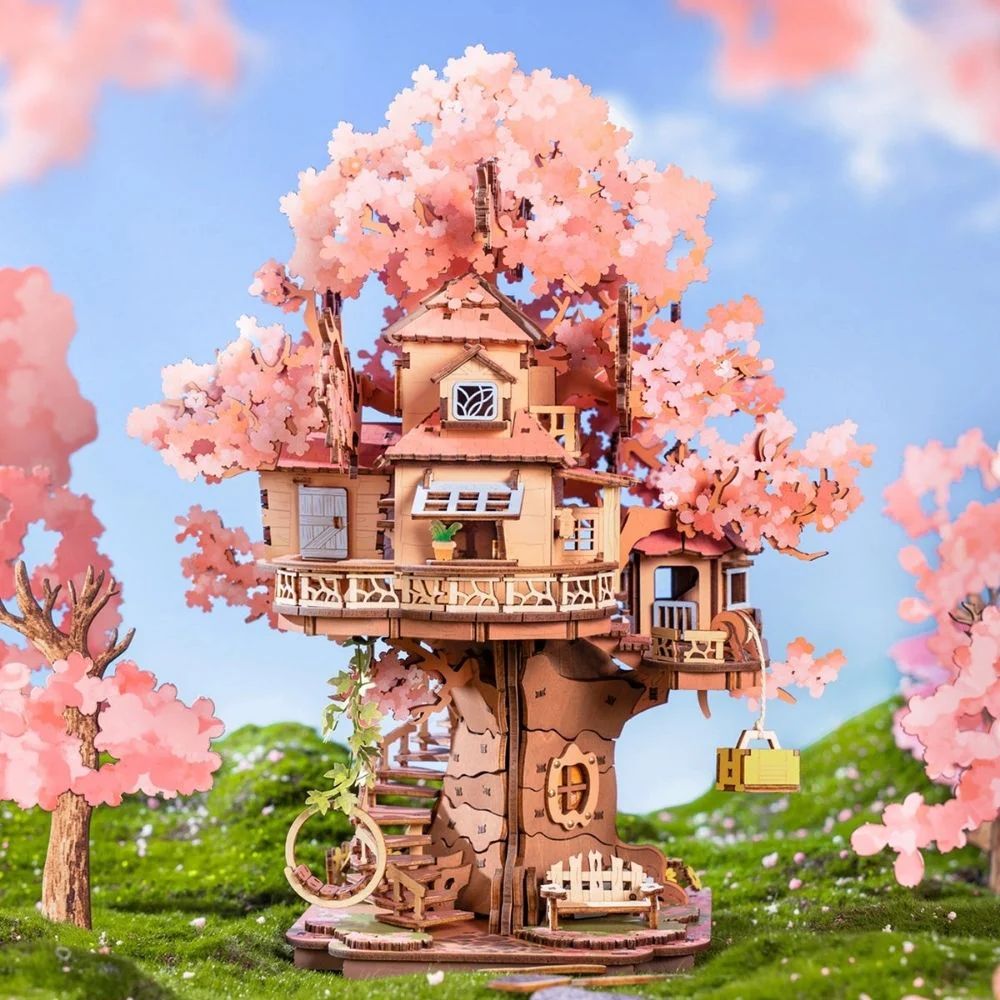
535 laser-cut components. A full multi-room treehouse with red tiled roof, wooden balcony, blue shuttered windows and wrap-around deck. A spiral staircase that actually winds. A rope swing hanging from a lower branch. A yellow lantern on a pulley system. A garden bench at the base. And above it all a layered sakura canopy built bloom by bloom, branch by branch, until the whole tree seems to breathe.
At 99.6 cm tall when assembled, this isn't a desktop ornament. It's a statement.
For experienced builders: this is the most ambitious kit in the 3D puzzle series. The canopy assembly alone, hundreds of layered bloom clusters built outward from the main branches is a session in itself. Plan for two or three sittings. It's worth every one.

Every element of the Sakura Tree House was engineered to be looked at from a distance and up close because at nearly a meter tall, it has to earn its space from every angle.
The Treehouse Structure The main house sits on a circular platform deck, its red tiled roof built from dozens of individual slat pieces. Blue-shuttered windows open on three sides. A wraparound balcony with carved railing runs the full circumference of the platform. Inside the rooms visible through the windows furniture details are present: a shelf, a chair, the suggestion of a life being lived somewhere above the ground.
The Spiral Staircase The wooden staircase winds up the trunk from the base garden to the main deck. Each step is a separate piece; the handrail follows the curve without a single straight section. It's the assembly sequence most builders describe as meditative repetitive, rhythmic, and deeply satisfying when the last step locks into place.
The Rope Swing A simple wooden swing hangs from one of the lower branches on a thin cord. It's one of the smallest elements in the kit and the one that makes the whole scene feel inhabited. Someone left it there. Someone will come back.
The Lantern Pulley A yellow lantern hangs from a small pulley mechanism on the side of the tree. It's the kind of functional-looking miniature detail that makes you look at the whole kit differently this isn't just decoration, it's a place where someone figured out how to get things up and down.
The Base Garden At the ground level: a white picket garden fence, a wooden bench, small flower clusters, ivy creeping up the base of the trunk. The base platform is wide enough to give the tree visual stability it doesn't look precarious, it looks planted.
The Sakura Canopy This is the defining element of the kit and the longest assembly section. The canopy is built in layers main branches first, then secondary branches, then bloom clusters added outward from each tip until the tree fills its full 42 cm width. Each bloom cluster is a separate piece. The pink deepens toward the outer edges; the inner branches show bare wood between the blossoms, exactly as real sakura do at peak bloom. At full assembly, the canopy is dense enough to cast real shadows on the trunk below.

Cherry blossoms are the most recognized symbol in Japanese culture — and also one of the most misunderstood outside Japan.
Sakura (桜) don't represent spring in the way that daffodils represent spring in the West as a simple seasonal marker. They represent something more specific and more complex: the beauty of impermanence. In Japanese aesthetics, this concept has a name — mono no aware (物の哀れ) which translates roughly as "the pathos of things," or the bittersweet awareness that all beautiful things are temporary, and that this is precisely what makes them worth stopping for.
Cherry blossoms bloom for roughly two weeks each year. They fall before they wither. Japanese culture has organized centuries of poetry, painting, and collective ritual around this window hanami (花見), the tradition of gathering beneath sakura trees to eat, drink, and simply be present in something fleeting and perfect.
The sakura treehouse sits inside that tradition. It's a place above the ordinary world, hidden in the branches of a tree that blooms briefly and extravagantly exactly the kind of place you'd want to be during hanami. Building it is its own version of that attention: slowing down, working carefully, staying present with something that requires your full focus.
There's also a specifically Japanese relationship between treehouses and childhood imagination one that runs through the works of Studio Ghibli, through My Neighbor Totoro's camphor tree, through the tree-top worlds that appear again and again in Japanese children's literature as places where the rules of the adult world simply don't apply. The Sakura Tree House carries that feeling. It's a place for people who never fully stopped believing in that kind of refuge.



A Creative Moment Worth Slowing Down ForReady to step away from the screens and remember what it feels like to make something with your hands? At Ecocraft, we design responsible, thoughtfully crafted DIY kits built for exactly that bringing people together around a shared experience that's equal parts relaxing and rewarding. From realistic scenes to fantastical worlds, each wooden kit invites you to build a unique miniature from scratch, rich in detail and alive with character. Clear instructions and premium sustainable materials mean anyone can dive in, regardless of age or experience. Picture the finished scene: the warm glow of the LED light, the last piece clicking satisfyingly into place, and the quiet pride of having built something beautiful together.

You've always dreamed of a little magic on your bookshelf and you never have to leave your living room to find it. A book nook pulls you into a miniature world where every carefully placed detail tells its own story. Build it piece by piece at your own pace, guided by our illustrated manual, and discover the quiet joy of watching something extraordinary take shape in your hands. Premium sustainable wood, built-in warm LED lighting, and a support team with you at every step mean this kit is made for everyone first-timers very much included. Picture your shelf transformed: soft golden light, delicate textures, and that deep, unhurried smile of someone who just made something they're genuinely proud of. With Wood-miniatures, it's never just a decorative object. It's a moment you'll remember.


